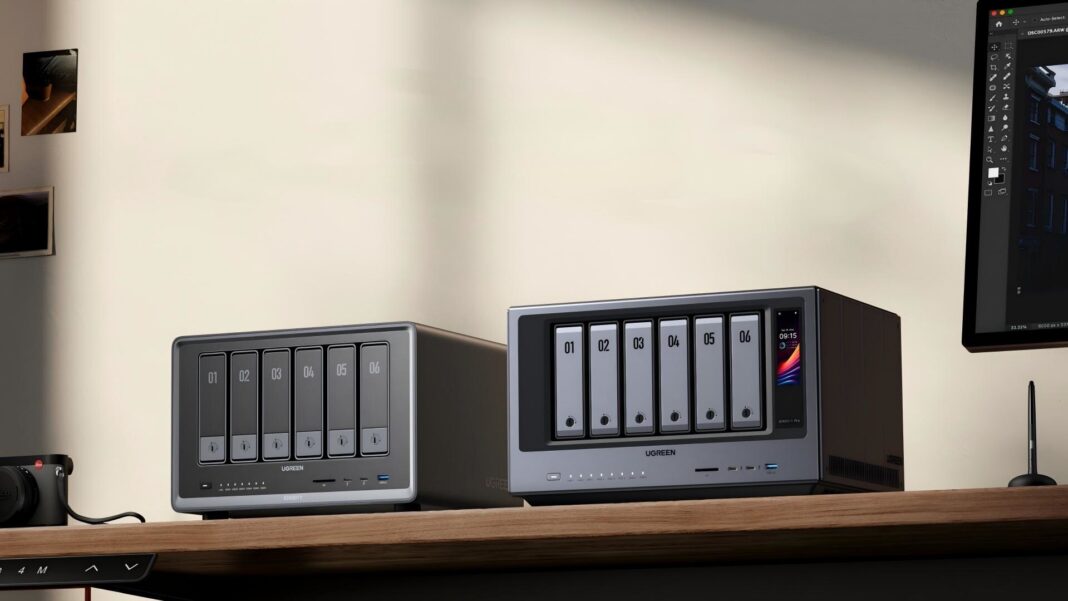
UGREEN used CES 2026 to unveil a major expansion of its NASync smart storage family with the new iDX Series, bringing intelligent local AI storage that feels like a private cloud right in your home or small business. The series introduces two next-generation network-attached storage systems that combine powerful hardware with on-device AI to change how people store, find, and interact with their data.
The new lineup includes the NASync iDX6011 and the NASync iDX6011 Pro. Both systems are built around Intel Core Ultra processors and packed with features like high capacity LPDDR5x memory, dual 10GbE networking, and dual Thunderbolt 4 ports. Storage can scale up to nearly 200 terabytes, making these systems suitable for creators, studios, families, and professionals handling large libraries of photos, videos, and documents.
What makes the iDX Series stand out is its secure Local AI Engine that runs on the device instead of in the cloud. This allows users to search for files using natural language, automatically organize content, and interact with data through built-in AI tools without compromising privacy. Users can describe a moment, idea, or memory and quickly surface relevant content stored on the NAS.
The AI features also include an onboard chat interface for querying stored files, organizing photo libraries by recognizing faces and objects, processing voice note transcripts, and summarizing content. This approach reimagines traditional network storage as an active and intelligent partner rather than a passive repository of files.
UGREEN also revealed pricing and availability plans. The NASync iDX6011 starts at $1,599 for the base configuration, while the NASync iDX6011 Pro begins at $1,999. Early pre-orders include special pricing that offers savings off the suggested retail prices, and the systems are expected to begin shipping in the coming months with broader availability to follow.
With the iDX Series, UGREEN aims to redefine what a NAS can be by putting robust AI capabilities and high-performance hardware into an accessible platform. For users who manage large amounts of digital content, this marks a significant step toward smarter, more intuitive local data storage and management.